



We may have spent the last week of January shivering and staring at the ice and snow, but here’s the truth: spring will be here before you know it. Once spring starts in Katy, severe thunderstorms become a major part of a homeowner’s life.
When most people think about storms they think “roofing issue,” not “plumbing issue.” But Katy has flat terrain and a heavy clay soil that can cause complications when rainfall gets heavy.
Take these steps to prevent damage and potentially save thousands.
Step 1: Check Your Main Sewer Cleanout
What is your main sewer cleanout?
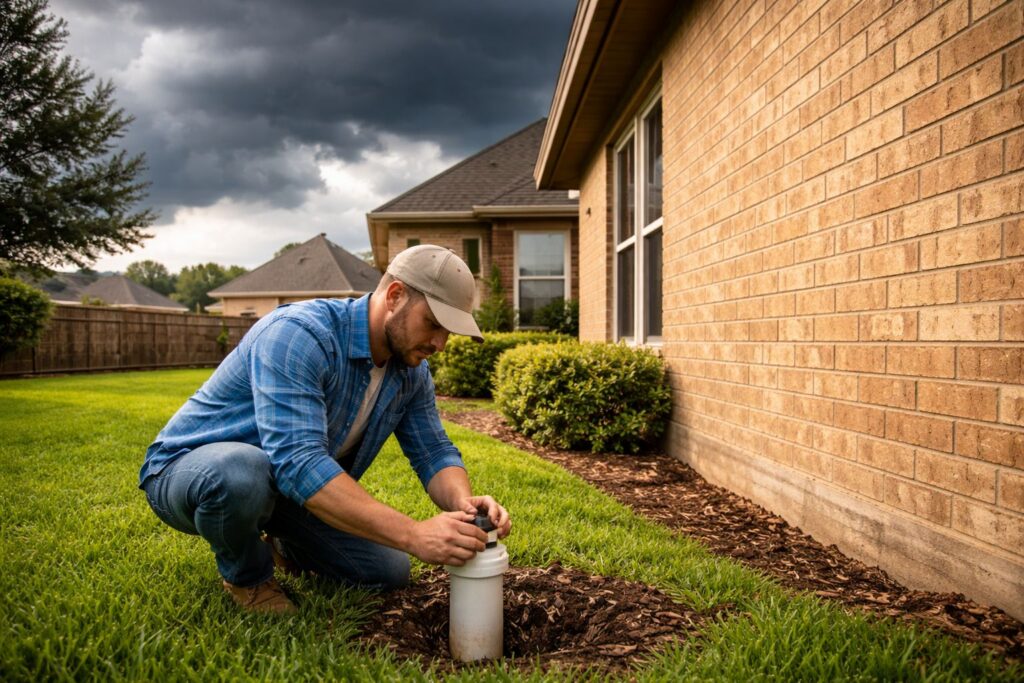
Have you seen the white PVC caps in your yard? This capped, vertical pipe actually provides direct access to the sewer line. It’s the same access we use to perform a sewer line camera inspection. We also use it to remove clogs and prevent sewage backups.
Why is it so important to check your main sewer cleanout?
While you don’t need to do anything to your sewer line directly (and shouldn’t), you do need to ensure the caps are tight and unbroken. If you don’t, surface debris like leaves and sticks can enter your line, causing backups and overflows.
You can usually find the pipe plug cap or fitting for less than $4 at Lowes or Home Depot.
Step 2: Locate Your Shut-Off Valve
Where is the water shut-off valve?
You’ll usually find it in one of these locations:
- On the side of the house closest to the street on an exterior wall.
- Near the water heater, furnace, or laundry hookups in your garage.
- At the water meter near the street.
There are two types. One uses a lever handle called a ball valve. You’ll turn it 90 degrees to shut off the water main. The other is called a gate valve and it looks like a round multi-turn knob. Turn it clockwise to tighten it and shut off the water.
Why is it so important to learn the location of the shut-off valve?
Every adult in your household should know the location of the shut-off valve. Heavy rains can cause Katy’s clay soil to become saturated. When that happens it tends to shift, which can break or crack underground pipes. Flooding can also cause excessive water pressure which can in turn cause pipes to burst.
If something goes wrong with one of your pipes, shutting off the water in 30 seconds, instead of taking 30 minutes to find the water shut-off valve, can mean the difference between a mop job and a full remodel once the plumbing gets fixed.
Step 3: Schedule a Pre-Storm Inspection
Why should you schedule a pre-storm inspection with Acosta Plumbing?
Pre-storm inspections can help us find potential danger and damage points before the storms start. Plus, our hydro-jetting service can help clear stubborn roots before the rain hits, removing strain on your system.
Don’t wait for the first lightning strike to wonder if your drains are clear or your plumbing is good to go. Call Acosta Plumbing to schedule a preventative maintenance check today.